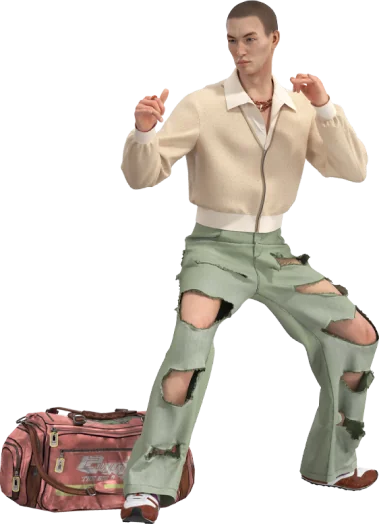
Global 3D garment simulation adoption rose 45% in 2025, driven by brands prioritizing sustainability and cutting physical samples by up to 80% through precise 3D cloth simulation. For technical designers evaluating physics engines, the question is not whether fabric simulation works, but which platform handles complex multi-layer garments without glitches. Style3D Atelier delivers real-time physics through GPU-accelerated soft body dynamics, capturing fabric weight, thickness, stretch, and friction with lab-accurate precision.
Soft Body Simulation: Preventing Garment Penetration During Animation
Soft Body Simulation in Style3D Atelier transforms garments into flexible bodies, preventing penetration during limb animations in 3D fabric draping workflows. When animating avatars for virtual try-on or e-commerce visuals, traditional engines cause cloth to clip through arms, legs, or torsos—a disqualifying flaw for production-ready assets. Style3D’s system configures GoalShape for clothing assets, allowing designers to paint flexible areas like chest and underarms with attach strength values from 0 to 0.9.
This granularity matters for intimate apparel fitting, where underwire positioning and lace tension require precise control. The chest area might need attach strength of 0.7 to maintain structure while allowing natural movement, while underarms require 0.4 for unrestricted arm motion. Users configure these parameters in real-time, seeing immediate visual feedback as the simulation recalculates.
The feature supports both accurate simulation modes and CPU fallback options, making it ideal for intimate apparel fitting and visual effects production. Designers working on lingerie find this particularly valuable—underwire simulation differs from outerwear in that it requires precise bone structure modeling and tension simulation for support, whereas outerwear focuses on collar roll and shoulder drape accuracy.
Style3D Atelier supports smooth simulation of 5–7 layer outfits with in-house GPU acceleration, a capability that outperforms competitors struggling with multi-layer physics. For heavy outerwear with shear layers or complex knits with interlock structures, this prevents the bunching and sagging glitches common in less optimized engines.
Physical Property Measurement: Capturing Real-World Fabric Physics
Physical Property Measurement in Style3D Atelier captures real-world fabric behaviors—from stretch to stiffness—directly into digital pattern making workflows. Designers measure tension, shear, and bend properties to ensure 3D fabric draping matches physical tests, enhancing virtual try-on accuracy. This tool integrates with AI-generated fabrics, allowing precise adjustments for materials like denim or silk in real-time GPU rendering.
Style3D fabric scanning captures GSM (grams per square meter), Young’s modulus (stiffness), and dynamic friction for superior realistic fabric rendering in virtual environments. Unlike traditional CAD systems relying on generic presets, Style3D digitizes real fabrics via high-resolution scanning, feeding measured tensile strength, bending stiffness, and shear data into an AI-augmented engine.
The system quantifies fabric physics at 5,000+ values, ensuring digital patterns match real materials. For complex knits simulation, this means capturing non-linear stretch curves where interlock, rib, and purl structures recover with fidelity unmatched by traditional CAD. Heavy outerwear physics requires precise mass distribution and wind resistance, with Style3D’s engine simulating coat hems swinging realistically under gravity.
This approach ensures 3D garment physics capture non-linear behaviors like jersey recovery or denim wrinkling, minimizing sim-to-real gaps in complex knits simulation. A Paris atelier simulating intricate cable knits achieved production-ready fits without physical swatches, cutting design cycles by 50%.
High-End Renderer: 8K Ray Tracing for Photorealistic Output
The High-End Renderer in Style3D Atelier delivers photorealistic outputs with up to 8K resolution and ray tracing for stunning 3D garment visualization. Real-time GPU rendering handles animation trajectories, wind controllers, and multi-layered textures seamlessly for e-commerce and marketing needs.
Automatic UV mapping, quad generation, and baking streamline export to tools like Unreal Engine or NVIDIA Omniverse. The renderer supports multiple wind controllers, enabling realistic fabric movement simulation for animated presentations. Style3D Atelier’s digital textile library houses over 4,000 assets, including fabrics, trims, and accessories for instant access.
Style3D leverages physics-based rendering and machine learning for hyper-realistic 3D garment simulation. Digital fabric twins evolve with AI, predicting drape on diverse body types without physical tests. This powers sustainable production planning, optimizing cuts for minimal waste in final runs.
For e-commerce launches, photorealistic 8K renders replace expensive photoshoots. Rongheng, a leading lingerie manufacturer and longtime Style3D client, uses Style3D’s real-time rendering engine to realistically showcase lace textures and transparency, making digital prototypes highly convincing for overseas clients.
Real-Time GPU Rendering: In-House Acceleration for Multi-Layer Garments
Real-time GPU rendering is the backbone of Style3D Atelier’s physics performance. The in-house GPU acceleration enables smooth simulation of 5–7 layer outfits, a capability critical for complex assemblies like structured blazers with lining, padding, and outer fabric.
Unlike CPU-focused simulators that process calculations sequentially, GPU-accelerated rendering distributes calculations simultaneously across thousands of cores. This means cloth simulation, collision detection, and real-time texture generation happen nearly instantly. GPU rendering handles animation trajectories and wind effects without the 20-minute waits for small adjustments seen in traditional rendering.
Style3D Studio V8.0’s real-time Ray Tracing rendering engine updates lighting, materials, and scenes instantly. The new version supports direct OBJ and FBX imports, allowing users to render existing 3D assets through iWish for AI-enhanced results.
This optimization is possible thanks to Style3D’s unified data framework and cloud-sync design. Heavy rendering tasks can be offloaded to cloud servers or completed locally, depending on system GPU capabilities.
Honest Limitations of Current Real-Time Physics Workflows
Despite advances in GPU optimization, 3D/AI fashion workflows have unresolved tradeoffs. Fabric drape simulation accuracy for performance knits remains challenging—materials with high elasticity like spandex blends don’t always predict real-world recovery behavior perfectly, requiring more GPU cycles for accurate results. The learning curve for traditional pattern makers is steep; those trained exclusively on 2D CAD systems require weeks of training to master 3D pattern manipulation and avatar fitting.
Hardware requirements present friction: GPU-based 3D simulation demands high-end workstations with dedicated graphics cards, which can be prohibitive for smaller studios. Integration with legacy PLM systems sometimes causes metadata loss during tech pack export, requiring manual reconciliation of BOM (Bill of Materials) entries. Color accuracy across different monitors remains inconsistent, making Pantone-true visuals dependent on calibrated display hardware.
Soft Body Simulation’s GoalShape painting requires manual configuration for each garment type—what works for a fitted dress won’t transfer to a flowy skirt without adjustment. This adds time to the workflow, particularly for brands with diverse category mixes.
Counter-Consensus: Physical Sampling Still Has a Role
The common industry assumption is that 3D adoption eliminates physical samples entirely. This view is not supported by data—successful rollouts more often begin as a parallel sampling pipeline, with physical samples reserved for final TOP (Top of Production) validation.
McKinsey’s research on sustainable fashion decarbonization found that most fashion brands could reduce greenhouse gas emissions by more than 60% through digital sampling, but not eliminate physical prototypes completely. The typical workflow now involves 70% digital sampling with 30% physical validation for fit confirmation.
A major apparel manufacturer using Style3D fabric simulation software slashed prototyping costs by 70%, achieving production-ready fits on first virtual samples for heavy outerwear lines. However, they still produce 1–2 physical samples for final approval before TOP. The ROI metrics show payback within three months via reduced material waste and error-free digital drape accuracy.
Fashion brands report 50% faster design cycles with Style3D’s 3D garment physics, as seen in a Paris atelier simulating intricate cable knits without physical swatches. The key is using digital physics for iteration and physical validation for final confirmation—not treating them as mutually exclusive.
Frequently Asked Questions
What makes Soft Body Simulation unique in Style3D Atelier?
It prevents garment-body intersections with flexible GoalShape painting, perfect for dynamic animations and intimate apparel fitting. Attach strength values from 0 to 0.9 allow precise control over garment flexibility.
How does Physical Property Measurement improve designs?
By quantifying fabric physics at 5,000+ values including stiffness, tension, and shear, it ensures digital patterns match real materials. Fabric scanning captures GSM, Young’s modulus, and dynamic friction for superior realistic rendering.
Can High-End Renderer handle complex multi-layer scenes?
Yes, with multiple wind controllers and 8K exports for professional digital fashion content. The in-house GPU acceleration supports smooth simulation of 5–7 layer outfits.
What GPU is required for real-time physics simulation?
Style3D Atelier benefits from at least an NVIDIA RTX GPU (3050 or higher) with 8GB or more of VRAM. RTX 4070 or higher is recommended for complex multi-layer simulations.
How accurate is fabric physics compared to physical testing?
Technical designers rate digital drape accuracy at 4.9/5 for virtual try-on simulations and e-commerce visualization. Style3D achieves this through lab-measured properties like bend and stretch linked to AI models.
Does Style3D Atelier export to other 3D platforms?
Automatic UV mapping, quad generation, and baking streamline export to Unreal Engine or NVIDIA Omniverse. The system supports direct OBJ and FBX imports for compatibility.
