Fashion product lifecycle management software, or fashion PLM, helps apparel teams manage the information and decisions needed to develop a style. A style record can connect its materials, bill of materials, measurements, tech pack, samples and approvals. The value of that record is that a designer, sourcing manager and supplier can each identify the version that applies to their work.
When choosing a system, ask to see what happens after someone changes an approved detail. A product demonstration might show how to create a style and publish a tech pack. An apparel team also needs to see what happens to the supplier’s copy, the sample request and the production record when one of the specifications changes.
What belongs in an apparel style record?
Start with a stable style ID, then identify the dimensions of the style your team needs to track, such as season, colourway, size range and supplier. An approved colour for one factory may depend on a particular fabric reference. A zipper that applies to every colourway can live in a common bill of materials, while the zipper tape colour may vary. The system should make that relationship readable when a person opens or exports the record.
A development record also needs to show the state of each decision. The designer may have approved the silhouette while sourcing is waiting for a material confirmation. A sample review can be complete for one size while other fit checks are still open. Test whether reviewers can see those distinctions without relying on a message thread or a status that applies to the entire style.
A bill of materials lists the components that go into the garment. A tech pack communicates the specifications, drawings, construction instructions and other information a supplier needs for the task. A useful PLM setup lets teams identify the bill of materials and measurements that an issued pack actually contains. If the online fields change later, the team should still be able to retrieve or identify the version sent to the factory. Style3D guide to pattern production and tech packs
Who updates records and who needs to read them
Give designers, technical developers, sourcing and vendors explicit responsibilities. A designer may propose a color; a materials owner may approve the supplier code; the sample room may need read access only to the released instructions. Test the same relationships with another product type, such as footwear or accessories, if the organisation intends to put those products in scope.
Decide which system owns each record
Pattern and garment design tools hold editable geometry and virtual samples. Product data management, often called PDM, covers product files and revisions and can sit within a larger PLM setup. PLM can coordinate specifications and development decisions across roles. An enterprise resource planning system, or ERP, often handles business transactions such as purchasing, stock and financial records. The exact split varies by company. Write down where each record is created, where it is edited and where a released version is used.
The same principle applies to 3D assets. A pattern maker may keep the editable project in the authoring tool while a technical reviewer uses a shared view of the same garment. The PLM style record can carry an asset reference and the review decision. Specify whether a link opens the latest asset or the revision that was actually approved. If a reviewer opens a moving link during a later audit, the asset may have changed since sign-off.
Style3D’s published Carhartt WIP case study describes one implementation in which PLM holds product information and Style3D Cloud and StyleBoard support shared visual work with digital assets. The case shows how the roles can be divided in that deployment. Ask a vendor to demonstrate the relevant connection with your own systems, data and access requirements. Carhartt WIP case study
Use a changed component to test the workflow
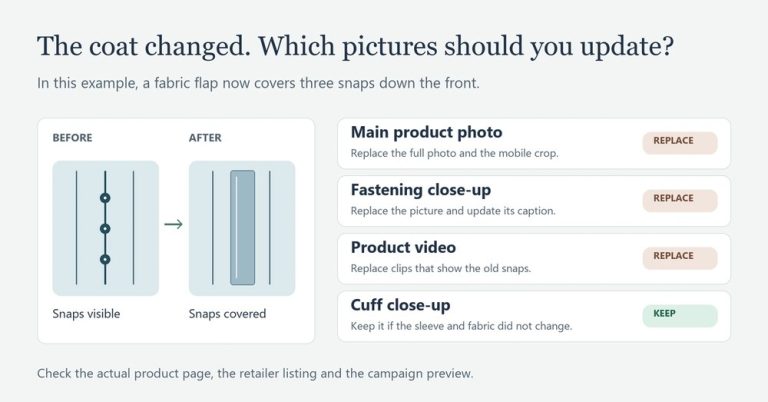
Bring a representative style and its current tech pack, material records and sample status. Suppose the team is developing a rain jacket and needs to replace a zipper after the first sample review. Ask sourcing to identify the new part and mark the original as superseded for the affected colourway. Have technical design check changes to the zipper length, seam treatment and any associated measurements. Identify which cost and construction approvals still need attention.
Then issue the next version and ask a supplier user to retrieve it. They should be able to tell which colourway the change applies to, which instructions are current and what check the next sample is meant to answer. Ask them to open an older pack as well. Check whether its issue date and revision remain clear and where the team records that it has been superseded. If your organisation sends PDFs by email, test how the new issue is identified in that workflow too.
Complete the trial by releasing the style to the next system or role. Try a record with a missing required field or a component ID the receiving system cannot match. Find out how the problem appears, who can resolve it and whether retrying the transfer creates another record. If the vendor proposes an integration, ask it to show the fields that move, the direction of transfer and which changes require review before they move. These details determine whether the team can rely on the handoff when an exception occurs.
Use product records that reflect the actual scope. An apparel style may need a size table and construction notes; an accessory might need different components or dimensions. Repeat the test with whichever categories and suppliers will be included.
Check migration and supplier access with real roles
Pick a set of existing styles that includes material name variations, an older tech pack and a carryover product. During a migration trial, check which items become structured fields, which remain attachments and how the team can open historical approvals. When two material records refer to the same fabric, decide who resolves the duplicate and how both references are traced. A clean demonstration with new sample data leaves those migration questions open.
Use real roles for access testing. A supplier should see the appropriate style, issued instructions and tasks for their work. An internal sourcing user may also need cost and supplier details. Check these views with accounts that match each role and with a record that involves more than one factory. Ask what happens to access when a supplier changes or a style is cancelled.
Look at the cost of maintaining the workflow as well as the cost of buying it. If someone has to recreate a colourway in two systems, carry that task into the evaluation. If a material can be entered once and retrieved where it is needed, identify who keeps it up to date. That gives the team a specific reason to choose the new workflow and a way to see how it performs during rollout.
When a new system is worth evaluating
If one person can issue accurate packs and suppliers can identify the latest one, a controlled template may be enough. A shared product record becomes more useful when several roles edit the same style, version conflicts recur, or a component change affects several products. Test which of those problems the new system would actually solve.
| Decision | Ask the vendor to demonstrate |
|---|---|
| Technical data | Reopen a previous pack and find the pattern and BOM that went with it |
| Supplier work | A receiving user can locate an issued pack and confirm the affected colorway |
| System handoff | A missing or rejected field is visible and has a responsible owner |
| Adoption | An ordinary team member can complete the same revision without the vendor running it |
Frequently asked questions
Does a small apparel brand need PLM?
It depends on the number of styles, suppliers and approvals it needs to coordinate. A small team can use a shared specification system if everyone can find the released files and trace changes. Consider PLM when that becomes hard to sustain or approvals repeatedly depend on manual reconciliation.
Can PLM replace the apparel team’s design tools?
Design and pattern work still needs an authoring tool that holds the editable design. PLM can identify which drawing, pattern or digital garment belongs to each style revision and which decision was made from it.
Do you need to connect PLM to ERP immediately?
A staged rollout can begin with a controlled release or export. Check the receiving workflow and document the field owners before automating the transfer. Integration becomes easier to evaluate once the team knows which decisions require synchronised data.
How do you measure whether a rollout is working?
Choose measures tied to a problem the team already experiences. For example, record how often a supplier asks which tech pack is current or how much time developers spend reconciling duplicate material records. Compare similar styles and note changes to the process that could affect the result.
References
- Style3D, Carhartt WIP: Connecting PLM, 3D and Global Teams
- Style3D, Pattern Production and Tech Packs