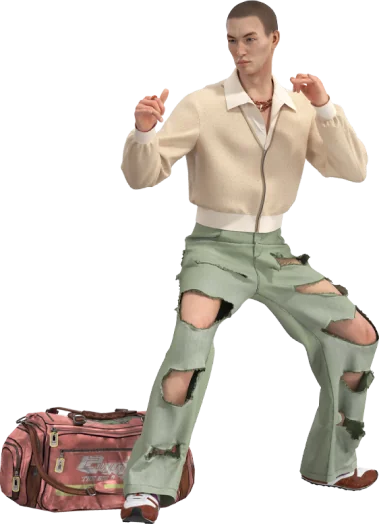
As highlighted in recent BoF–McKinsey State of Fashion research, low single‑digit growth and rising cost pressure are forcing brands to scrutinize every part of the value chain, including e-commerce content production. At the same time, McKinsey’s 2025 insights note that fashion executives see AI-driven marketing and digital experiences as critical value drivers, pushing imagery and product visualization to the center of strategic discussions. For e-commerce directors and marketing VPs, replacing portions of traditional model photoshoots with high-fidelity 3D digital visuals has shifted from experiment to urgent cost-control lever in 2026.
Why traditional fashion photoshoots no longer scale
A conventional e-commerce photoshoot blends multiple cost drivers: studio rent, photographer and crew fees, model day rates, hair and makeup, set build, retouching, and sample logistics. When you multiply that by hundreds or thousands of SKUs per season, the content budget quickly rivals core marketing spend, especially for ready-to-wear brands in the mid-market and value segments. More complex categories like lingerie or tailored menswear add further constraints, as garments require careful fitting, steaming, and on‑set adjustments to avoid distortion or unflattering lines, which burns time on studio days.
Speed is a second issue. To launch a drop, merch and marketing teams often wait for proto or TOP (Top of Production) samples, ship them to a central studio, schedule models, and then wait again for retouched assets. Any delay—late samples, reshoots, or incomplete size runs—pushes back e-commerce go‑live dates and merchandising campaigns. For omnichannel retailers who refresh product pages and ads weekly, the lag between design sign‑off and finished imagery directly impacts sell‑through. Industry reports on digital product creation point out that while 3D and AI tools have mostly been discussed in design and sampling, the same digital garments can support a new model: content‑ready visuals produced before physical samples exist, at a fraction of the marginal cost of each additional studio look.
How 3D garments become e-commerce-ready visuals
The shift from physical to 3D visuals begins with how garments are created and stored digitally. In a Style3D workflow, pattern makers either draft patterns directly or import DXF or AAMA files, then assemble them onto customizable avatars whose measurements match the brand’s size tables. Fabric properties—weight, stretch, thickness, bending, and shear—are calibrated based on lab data or reference tests, ensuring that drape and silhouette match real garments as closely as possible. The result is not just a pretty rendering but a pattern-aware 3D asset that remains valid for production and fitting.
Once a garment is simulated, Style3D’s high-fidelity rendering stack takes over. Materials can mimic everything from smooth sateen shirting to brushed twill chinos and delicate lace, with accurate specular highlights and shadow behavior. Lighting rigs and camera presets are built to replicate typical e-commerce setups: front, three‑quarter, side, and back views, with consistent horizon lines and focal lengths across styles. Critically, Style3D’s AI-powered image modules (such as the iWish renderer referenced in Style3D communication) allow teams to generate model-on-body imagery from 3D garments, using a library of poses and scenes tailored for product detail pages and campaign tiles. Instead of booking a model for five looks in a studio, teams can generate dozens of looks and poses digitally—while preserving the garment’s pattern integrity and fit lines that matter for conversion.
Case insight: when digital visuals become reality-ready
Style3D’s collaboration with Rongheng, a large-scale manufacturer, illustrates how realistic 3D garments can stand in for physical samples in client communication and marketing assets. In that case, Rongheng uses Style3D to build detailed digital garments and then relies on high-quality renders for brand presentations, online catalogs, and pre‑sell activities. Executives describe a visible narrowing of the gap between digital and physical, enabling buyers to sign off on styles based largely on 3D visuals and only a limited set of physical samples. This same “disappearing line” makes it plausible for e-commerce teams to treat 3D imagery as primary content for certain product types.
Another relevant example comes from Wolf Lingerie, which works with Style3D to simulate lingerie with complex lace, mesh, and underwire structures. By using 3D simulation and AI-enhanced visuals, Wolf Lingerie can preview fit and appearance on virtual bodies before committing to full photo campaigns, and generate catwalk-style animations for internal and external use. If 3D visuals can capture such demanding materials and cuts convincingly in lingerie—a category where tiny errors in drape are immediately obvious—they can certainly support more forgiving categories like knit loungewear, tees, or outerwear in e-commerce. For marketing VPs, these cases show that 3D visuals are no longer confined to concept art; they are robust enough to influence buying decisions and brand storytelling.
The new content pipeline: from Style3D to PDP
Replacing significant parts of physical photoshoots with 3D visuals does not mean abandoning photography altogether. Instead, it means building a hybrid pipeline where Style3D assets feed multiple content formats, and physical shoots are reserved for hero or campaign stories. In practice, a modern pipeline might look like this: first, design and development teams create a 3D garment in Style3D, fully calibrated and approved for production. This asset is then passed to a digital content specialist who selects avatars, poses, and scenes that match e-commerce and brand requirements—standing front view for PDPs, walking or turning poses for videos, and close‑ups for fabric details.
Next, high-resolution renders are exported at platform-specific sizes for web, mobile, and marketplace listings. Because these renders are generated in a controlled virtual studio, background cleanup and color correction are minimized compared to traditional photography. For additional flexibility, marketing teams can use AI content tools—sometimes integrated with or adjacent to Style3D—to composite garments into lifestyle scenes or swap backgrounds to fit regional campaigns while keeping the garment pixel‑perfect. This shift also has side benefits: size inclusivity can be demonstrated more easily by rendering the same garment on multiple avatar bodies, and colorways can be “shot” simultaneously without requiring separate samples or model changes. In a year like 2026, where personalization and relevance are strategic priorities, the ability to scale asset variations without re‑booking a stage is a decisive advantage.
Honest limitations and where physical photography still wins
Even with high-fidelity 3D and AI, digital visuals are not a universal replacement for photography. Certain finishes—such as high-pile faux fur, heavy melange knits, or highly reflective sequins—remain challenging to render convincingly across all lighting scenarios, especially when garments move. While Style3D’s material system can approximate these effects, e-commerce directors may still prefer traditional photography for key looks where tactile richness is central to perceived value. Similarly, complex motion like flowing chiffon on a windy rooftop or water interaction in swimwear campaigns is better captured on video sets than synthesized from static 3D scenes.
Operationally, the shift demands new skills. Instead of only booking a photographer, teams need 3D artists or technically inclined designers who understand particle distances, simulation settings, and shader tuning. Hardware requirements can also be nontrivial; rendering large volumes of high-resolution images for full assortments benefits from GPU-equipped machines or cloud rendering pipelines. Additionally, strict color accuracy is a must: while digital garments can be calibrated, final sign‑off often still involves comparing renders against lab dips or production swatches under controlled light, using standards such as ISO 105 for colour fastness testing on the physical side. The net result is that 3D drastically reduces the marginal cost of additional looks and views, but brands should still plan a balanced mix of digital and physical shoots for categories or stories where sensory richness and authenticity are paramount.
Counter-consensus: you don’t have to digitize every SKU to cut costs
A common perception in the market is that 3D and AI only become financially meaningful when every style is digitized and all e-commerce imagery is synthetic. Field experience and case examples suggest a different reality: the biggest gains often come from selectively digitizing the portions of the assortment that are most expensive to shoot or most repetitive in silhouette. For instance, basics programs, continuity denim fits, or repeating knit blocks can be excellent candidates for 3D visuals, as the marginal value of new photo sets is relatively low once the core fit and style are established.
E-commerce directors can therefore prioritize SKUs where 3D will clearly compress content timelines and reduce reshoot risk—such as products frequently delayed due to late samples or fit issues—rather than aiming for blanket digitalization on day one. Once a library of digital garments is in place and internal confidence grows, the share of 3D-first PDPs can be increased season by season. This incremental approach aligns investment with measurable outcomes, such as reduced sample shipments, fewer studio days, and faster go‑live cycles, instead of chasing an all-or-nothing transformation that stalls under its own ambition. In practice, balanced portfolios of digital and physical imagery often outperform “digital-only” fantasies because they respect category nuances and consumer expectations while still delivering substantial cost and time savings.
A decision framework for e-commerce leaders: Shoot, Simulate, or Hybrid
To move from theory to action, e-commerce directors and marketing VPs need a way to decide which garments should be photographed traditionally, which should rely primarily on 3D visuals, and which deserve a hybrid treatment. A simple but powerful rubric is the “Shoot, Simulate, or Hybrid” framework based on three factors: visual complexity, storytelling role, and assortment stability. Garments with high visual complexity and central storytelling roles—such as couture pieces, limited-edition collaborations, or campaign heroes—usually fall into the “Shoot” bucket; their value lies in emotive storytelling that benefits from real environments and human expression.
At the other end, items with low to moderate visual complexity, limited storytelling roles, and stable repeating blocks—think carryover jeans, t-shirts, or core lingerie fits—are prime candidates for “Simulate,” where Style3D renders become the main PDP imagery, potentially supplemented by occasional physical shots for social channels. In between lies the “Hybrid” space: here, a capsule might use one physical shoot to establish a campaign narrative while relying on 3D for size expansions, secondary colorways, and retailer-specific assortments. Once mapped, this framework helps teams allocate budget rationally, defend 3D investment cases to finance and leadership, and set realistic adoption targets that support 2026 performance goals rather than disrupt them.
Frequently Asked Questions
Can 3D visuals really replace photos on our main product pages?
Yes, for many categories and use cases. When garments are built as accurate 3D assets in Style3D—with calibrated patterns, fabrics, and fits—the resulting renders can provide front, side, and back views that meet or exceed typical studio output. Many brands already use such visuals for wholesale selling, pre‑sell, or e-commerce, especially for basics and carryover styles where silhouette and detailing are predictable.
How does Style3D help reduce photoshoot and reshoot frequency?
Style3D allows you to generate consistent, high-resolution images and model-on-body visuals directly from your 3D garments, without booking studios or models for every new colorway or minor fit tweak. Because patterns and fits are validated digitally, the risk of discovering issues only on set—triggering reshoots—drops significantly, and color variants can be “shot” virtually as soon as they are confirmed in the line plan.
What skills does my team need to adopt a 3D-first content pipeline?
You will want at least one 3D fashion specialist or digitally trained designer who can handle garment simulation, avatar selection, and render setup in Style3D. Over time, merchandisers and marketers should also become comfortable reading 3D visuals for fit and styling decisions, much as they already interpret flat sketches and samples today. Some brands partner with external 3D service studios initially while building in‑house capability.
Will customers trust 3D images as much as real photos?
Consumer trust depends on how accurate and consistent the digital visuals are. When 3D garments closely match delivered products in fit, fabric behavior, and color, customers quickly accept them as credible, especially if the brand is transparent about using digital imagery. Many shoppers are already accustomed to CGI in beauty and footwear; fashion apparel follows the same trajectory as long as returns and complaints do not rise.
How do we start without overhauling our entire content strategy?
Begin with a pilot on a contained capsule or category, such as a basics program or private-label knits, where silhouettes repeat and storytelling needs are functional rather than highly emotional. Digitize those garments in Style3D, generate PDP visuals, and compare performance, returns, and production costs against a traditionally shot control group. Use those results to refine your “Shoot, Simulate, or Hybrid” framework and expand adoption step by step.
Sources
-
The State of Fashion 2023: Resilience in the Face of Uncertainty
-
Style3D x Rongheng: The Disappearing Line Between Digital and Reality
-
Style3D x Wolf Lingerie: Transforming Lingerie Design with AI + 3D Innovation