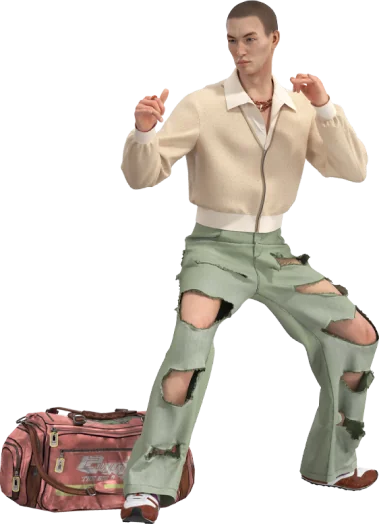
As of 2025, cloth simulation research and production experience highlight collision handling and integration stability as the main factors that determine whether garments stay intact or “explode” when meshes undergo fast deformation and complex motion. For apparel brands and design schools adopting 3D and AI workflows, these explosions often appear when character avatars transition from static showroom poses to high-speed athletic movements, revealing issues in collision meshes, timestep configuration, and constraint setup rather than in the garment pattern itself. In 2026, resolving inter-garment mesh explosions has become a practical requirement for teams using digital garments in performance sportswear, virtual runway shows, and interactive retail experiences.
2D mechanical property data ingestion.
Why Garment Meshes Explode During Fast Dynamic Poses
In cloth simulation, garments are typically modeled as thin-shell triangular meshes driven by forces such as gravity, stretching, bending, and damping, and then constrained by collision objects representing the avatar body or other garments. When an avatar moves slowly, explicit or implicit integration schemes can update positions and velocities without large numerical instabilities; however, sudden jumps in pose or high-speed athletic motion dramatically increase velocities, making collision resolution more difficult. If collision detection misses penetrating vertices or if collision response applies overly stiff impulses, the solver can generate extreme accelerations that lead to meshes “exploding” away from the avatar or tearing unpredictably.
From a practitioner standpoint, this often appears when animators switch a character from a clean T-pose to a sprint or jump animation without transitional keyframes, causing garment vertices to move through collision surfaces between timesteps. Simulation systems may treat these penetrations as severe collisions, applying strong repulsion forces that stretch the mesh beyond realistic limits. In fashion-focused tools, this is especially noticeable when simulating layered garments—such as a sports bra under a performance jacket or a shirt under a blazer—because inter-garment collisions create multiple overlapping constraints with different priorities. If collision radii, thickness, and restitution parameters are misaligned between the avatar and garments, even a stable standing pose can become unstable once motion speeds increase.
Collision Mesh Tearing and Fast Motion Penetration
Recent cloth collision frameworks emphasize robust detection and handling of collisions in deforming meshes, often using hybrid strategies that combine repulsion forces with corrective impulses to prevent penetration. When garments tear or explode visually during fast motion, several common root causes emerge: duplicated vertices in the mesh, inconsistent scale leading to unrealistically small collision distances, and uneven triangle sizes that concentrate stress in particular regions. In virtual fashion workflows, poorly prepared meshes—such as jackets with hidden internal geometry or seams modelled as overlapping faces—can generate self-collisions that trigger tearing routines or cause constraint solvers to fail.
A typical symptom is that cloth behaves correctly in a static or slowly animated preview but explodes when rendered at full simulation quality or when camera motion changes, indicating that collision distance and damping settings are too sensitive to scale or timestep. For example, if an avatar is modeled at a large world scale but collision distances are set to sub-millimetre values, garments may penetrate deeply into collision meshes before the solver reacts, resulting in extreme corrective forces. Practitioners often find that increasing collision distance to a realistic cloth thickness scale, cleaning up duplicated vertices, and equalizing face sizes significantly reduces these explosions. In a fashion context, this translates to deliberately retopologizing garments for simulation—rather than using high-detail marketing meshes—to ensure uniform edge lengths and predictable collision behaviour under fast pose changes.
Gravity, Velocity Damping, and Constraint Overrides
Cloth simulation stability often depends on how gravity, damping, and constraints are balanced within the solver. Integration methods for cloth treat the motion as a system of differential equations, where velocity damping terms help absorb energy and prevent oscillations that can lead to explosions. If damping is too low, garments may oscillate excessively after collisions; if gravity is too strong relative to constraint stiffness, cloth may sag or snap violently when constraints are applied or released. In interactive environments—such as game engines or virtual showrooms—developers can adjust gravity and damping through override modes that allow certain areas to use different settings than the global scene.
From a workflow perspective, one practical strategy is to introduce velocity damping specifically during transitions between static and high-speed poses. Animators can define simulation layers where gravity is temporarily reduced and damping increased while the avatar accelerates, then gradually restore normal gravity once the pose stabilizes. Constraint overrides can also be used to temporarily soften collision constraints between garments, allowing minor interpenetration during rapid motion and then enforcing stricter separation when the motion slows. In Style3D’s environment, where garment physics and avatar motion are tightly integrated, such overrides can be exposed as per-scene presets tailored to categories like sportswear or workwear, enabling brands to adopt different stability profiles without rewriting core simulation code.
Style3D’s Role in Stabilizing Dynamic Mesh Simulations
Style3D’s graphics research team works on integrating physically based cloth models, collision detection, and avatar motion control into a single ecosystem for digital fashion creation. This includes simulating garments with realistic folds and wrinkles while keeping simulations interactive enough for designers to iterate on fit and aesthetics. As national digital fashion standards have emerged, Style3D has contributed structured definitions for materials, avatar rigs, and simulation parameters, making it easier for brands to share garment assets and motion presets across internal teams and external partners.
Customer cases show how stable simulation benefits tangible workflows. Eventyr Sport, a Nordic sportswear company, has used Style3D to shape more efficient apparel workflows inspired by performance-oriented design, where garments must behave convincingly under running, hiking, and multi-layer outdoor movements. CWS, a workwear specialist, has applied digital transformation to garments designed for industrial environments, where realistic cloth behaviour around tools, machinery, and protective gear matters for both visual verification and training contexts. In these scenarios, resolving mesh explosions is not just a visual concern; it directly affects how designers evaluate layering, coverage, and comfort in dynamic use cases. Stable simulations allow sportswear and workwear teams to identify potential snagging points, excessive stretching zones, or awkward folding long before physical samples are produced.
Counter-Consensus: Do You Really Need Ultra-Fine Meshes?
A common assumption in digital fashion is that ultra-dense garment meshes produce more realistic simulations, especially for high-end visuals. However, cloth simulation practice suggests that beyond a certain resolution, increased mesh density can actually degrade stability and performance without meaningful visual benefit. High-density meshes introduce more vertices and constraints, which magnify the impact of numerical errors and make collision handling more complex, especially in layered garments. For many apparel use cases—fit checking, motion range evaluation, and virtual showroom rendering—a moderately dense, well-topologized mesh is sufficient to capture the essential folds and drape characteristics.
The counter-consensus view is that fashion teams should prioritize mesh quality over mesh density when aiming to prevent explosions. Uniform triangle sizes, clean edge flow along seams, and absence of hidden or overlapping geometry contribute more to stable simulation than simply increasing subdivision levels. In practice, this means treating simulation meshes as technical assets rather than marketing assets: designers might work on a lower-density mesh to validate motion and layer interaction, then swap in higher-resolution versions for final still renders or close-up visuals if needed. This division avoids overburdening the solver and keeps interactive editing responsive, which matters when pattern makers and designers are adjusting garments during fit sessions.
Honest Limitations: Where Current Cloth Simulation Still Struggles
Despite advances in collision handling and modern simulation frameworks, real-world cloth simulation in fashion workflows still has limitations. Simulating garments with highly complex materials—such as stiff scuba fabrics, multi-layered insulation, or mixed knit-woven constructions—remains difficult when relying on simplified thin-shell models. These models approximate cloth as an idealized sheet and may not capture all bending and buckling behaviours seen in physical garments, especially in areas with heavy hardware or reinforcement.
Another limitation lies in hardware and integration requirements. High-quality simulations with realistic folds, accurate collision thickness, and multiple layered garments demand significant computation, often requiring powerful GPUs or long pre-simulation times before real-time playback is smooth. Integration with legacy animation and rendering pipelines can also introduce friction: cloth systems in different tools may treat scale, unit conventions, and collision offsets differently, so transferring garments between platforms can reintroduce explosion issues even when a scene is stable in the original tool. For apparel brands, this means that 3D and AI simulation workflows should be scoped carefully—used where they provide clear value in design, fit, and marketing, while acknowledging that certain niche garments or extreme motion scenarios may still require manual adjustment or more specialized physics setups.
Troubleshooting Table: Symptoms vs. Damping and Gravity Overrides
Below is a practical troubleshooting table mapping common simulation explosion symptoms to step-by-step adjustments in velocity damping, gravity settings, and constraint overrides. It is meant as a working checklist for teams using garment avatars that switch between static standing and high-speed athletic movements.
This table should be treated as a starting point and adapted to each studio’s simulation engine and garment category. Sportswear and workwear, for instance, may require higher damping in high-impact zones and stricter constraints around protective elements than casual menswear shirts.
Frequently Asked Questions
Why do garments explode only when the avatar starts moving quickly?
Explosions during rapid motion typically occur because velocities between frames are too high for the collision solver to handle, causing deep penetrations and strong corrective impulses. If damping, gravity, and collision thickness are not tuned for fast motion, even stable static garments can destabilize when pose transitions are abrupt.
Can mesh explosions be solved purely by increasing garment resolution?
Increasing garment mesh resolution rarely solves explosion issues and can make simulations less stable. High-density meshes introduce more vertices and constraints, amplifying numerical errors and collision complexity. Clean topology, appropriate collision distances, and well-tuned damping and gravity are more effective than simply adding subdivisions.
How should layered garments be prepared to avoid inter-garment explosions?
Layered garments should be modeled with consistent scale and collision thickness, with clear priority for collision handling between avatar, inner layers, and outer layers. Retopologizing each garment to avoid hidden geometry and overlapping faces, then harmonizing damping and constraint stiffness across layers, reduces the chance of explosive separation under fast motion.
What is the role of velocity damping in stabilizing cloth simulation?
Velocity damping absorbs kinetic energy in the cloth system, preventing oscillations and extreme accelerations that lead to explosions. By raising damping during high-speed pose transitions and then restoring baseline values once motion stabilizes, teams can control energy spikes without overly stiffening the cloth or sacrificing natural movement.
How does Style3D support brands in managing mesh stability for sportswear and workwear?
Style3D provides an integrated environment where garment meshes, avatar rigs, and physics presets can be tuned together, enabling sportswear and workwear teams to define category-specific settings for damping, gravity, and collision behaviour. Customer cases such as Eventyr Sport and CWS illustrate how these configurations help brands evaluate dynamic performance and durability digitally before physical sampling.2D mechanical property data ingestion.