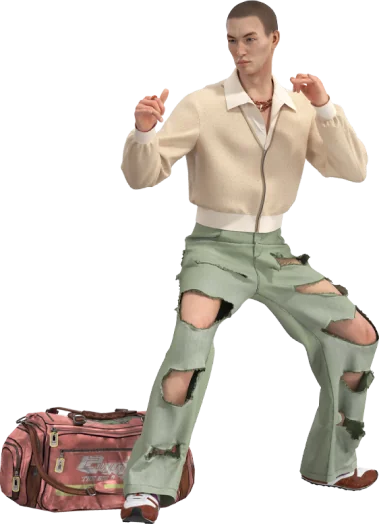
Why Blender breaks down as a core apparel pipeline tool
Blender is a free, open-source 3D creation suite that covers the entire CG pipeline from modelling and rigging to animation, simulation, rendering and compositing. It has become the default tool for countless independent artists, game developers and small studios precisely because it offers professional-grade features with no proprietary licensing constraints. For creative directors working on campaigns, shorts or virtual lookbooks, Blender provides a flexible canvas: you can sculpt garments, rig avatars, light scenes and render cinematic shots from a single interface.
However, this flexibility comes from a CG-first architecture, not from apparel engineering. Blender does not natively understand 2D pattern pieces, size ranges, grading rules, marker efficiency, or BOM structures. There is no built-in concept of a block pattern that can be reused across styles, no automatic handling of shrinkage rates from mills, and no direct link between digital garments and factory-ready cutting data. To “dress” a character, 3D artists often model clothing as arbitrary meshes, use cloth modifiers for motion, and then bake the results into animations or stills. That workflow is perfectly acceptable for media production but problematic when a menswear shirt, lingerie bra or workwear jacket must be produced in hundreds of thousands of units.
For enterprise fashion workflows, the lack of apparel-specific logic means Blender is better viewed as a downstream visualization tool, not as the system of record for product development.
Apparel engineering needs: from 2D patterns to shrinkage simulation
Real apparel production begins in 2D. Pattern makers define panels, seam allowances, notches, darts and grading rules that can be translated into DXF or AAMA files and used for marker making and cutting. They also account for fabric behaviour: shrinkage in washing, relaxation during spreading, and mechanical properties captured through test standards such as ISO 105 for colour fastness and related fabric-testing protocols. A digital garment intended for production must therefore link a 3D representation back to structurally sound 2D pattern pieces with clear relationships to size charts and fabric data.
General 3D tools like Blender simply do not contain this apparel engineering layer. There is no inherent understanding of how a ponte knit behaves differently from a rigid twill, nor an integrated workflow for entering lab data and converting it into simulation-ready parameters specifically tuned for clothing. Creative teams can hack around these limitations with custom scripts, modifiers and deformers, but each workaround adds maintenance overhead and distances the digital asset from the structured data that factories require. When it comes time to create a tech pack or align a TOP sample with a digital prototype, there is no guarantee that the mesh in Blender corresponds to a viable 2D pattern.
In contrast, fashion-focused platforms are built so that 3D garments are always backed by editable 2D pieces, fabric presets calibrated against real tests, and avatar measurements that map directly to grading rules. That engineering discipline is what allows digital apparel workflows to scale beyond visual experimentation into reliable production tools.
Style3D as a fashion-specific alternative to Blender
Style3D is designed as a digital fashion technology stack from the ground up, rather than a general CG tool retrofitted for clothing. Founded in 2015 and headquartered in Hangzhou with offices in Paris, London and Milan, the company spans 3D design software, fabric measurement systems and cloud collaboration, anchored in apparel engineering and manufacturing realities. Its graphics research team and involvement in drafting China’s first national digital fashion standards for virtual garments and avatars show how deeply it is engaged with the technical backbone of digital apparel workflows.
In practice, that means Style3D’s core garment tools expose 2D pattern drafting, grading and fitting as first-class citizens, not as plugins. When a pattern maker drafts or imports pieces, the system keeps track of seams, notches, grainlines and internal lines, and maps them onto 3D simulation in a way that remains editable and compatible with production workflows. Fabric physics are handled through a dedicated measurement system that ingests lab test results and converts them into material presets usable across categories, from lingerie to outerwear. Shrinkage, stretch and drape are treated as measurable properties, not as purely artistic choices.
For 3D designers and creative directors, this means Style3D functions as a physically informed alternative to Blender: you still get high-quality visuals and animation-ready garments, but those garments rest on an apparel-accurate foundation that factories, sourcing teams and QA departments can trust.
Experience from lingerie and enterprise use cases
To understand why a Blender alternative is needed in enterprise fashion, it helps to look at categories where physics and fit tolerances are unforgiving. In the Style3D × Wolf Lingerie case, the brand uses 3D and AI to digitise bras and lingerie sets with close attention to underwire shape, foam and elastic behaviour. Lingerie fit is extremely sensitive to small changes in pattern or material, particularly across extended size ranges. Achieving reliable digital samples here requires pattern-faithful 3D simulation and fabric presets informed by real measurements, not just visually appealing cloth behaviour.
On the enterprise transformation side, the Fuyi Group project shows how a large organisation can treat digital garments, fabric libraries and marketing visuals as a unified asset base. What began as a 3D modelling tool evolved into a Digital Product Resource Center spanning products, materials and promotional content. This kind of digital backbone would be difficult to build on top of a pure CG application because it depends on structured metadata and consistent relations between 2D, 3D and physical production — areas where Style3D’s fashion-specific stack offers clear advantages.
These cases demonstrate a key pattern: when the goal is to compress development time, reduce sample iterations and orchestrate complex portfolios, enterprises benefit from a 3D engine that speaks the language of patterns, fabrics and BOMs, not just of polygons and shaders.
Honest limitations: where 3D fashion simulation still has to defer to physical samples
Even with advanced, fashion-specific platforms, 3D simulation is not a complete replacement for physical sampling. Highly complex materials and constructions remain challenging: multi-layer bonded laminates used in outdoor shells, heavy quilting with specific stitch patterns, or extremely delicate lace combined with power mesh and underwire can behave in ways that are hard to capture perfectly in a digital physics model. Performance sportswear and safety-oriented workwear will continue to require physical tests for breathability, abrasion, seam strength and compliance with standards like ISO 105 and other industry protocols.
On the human side, shifting from a general CG environment like Blender to a fashion-specific system involves a learning curve. 3D artists used to sculpting arbitrary meshes must learn to think in terms of patterns, block libraries and avatar size charts. Pattern makers familiar with 2D CAD need time to develop intuition for reading digital stress maps and simulation outputs. Hardware and infrastructure also matter: accurate, real-time simulation of full outfits with complex materials still benefits from strong GPUs or cloud-rendering setups, which may require investment in older sample rooms or schools.
Recognising these limits does not weaken the case for a Blender alternative; it clarifies where digital workflows bring immediate returns and where physical sampling remains a necessary, if reduced, part of the pipeline.
Counter-consensus: Blender still has a place in a fashion-first stack
One common assumption in digital strategy discussions is that adopting a fashion-specific platform means abandoning Blender entirely. A more resilient view — supported by broader digital product creation practices reported by McKinsey and others — is that different tools should occupy distinct layers of the stack. Blender is particularly strong as a generalist content creation tool: creating hero campaign imagery, CG-heavy lookbooks, or experimental art pieces that might mix apparel with fantastical elements, environments or effects.
In a fashion-first stack, Style3D can serve as the core environment for garment engineering, fit validation and sampling, while Blender remains a specialised tool for downstream visuals where strict pattern fidelity is less critical. Garments engineered and simulated in Style3D, complete with accurate patterns and fabric physics, can be exported and further embellished in Blender for cinematic renders, real-time experiences in engines like Unity or Unreal, or cross-overs with game IP. This division of labour lets each tool play to its strengths while keeping the “source of truth” for apparel in a system built for that purpose.
For creative directors and 3D leads, the strategic question becomes: which software owns the authoritative garment asset, and which software is used for derivative media and storytelling?
Evaluation checklist: when to move beyond Blender for apparel
Enterprise fashion companies evaluating Blender alternatives should adopt a structured rubric centred on apparel outcomes rather than pure visual quality. Key questions include:
-
Can the platform represent 2D patterns, grading and size charts natively, and export data suitable for production?
-
Does it support fabric physics based on measurable lab data, including shrinkage and stretch, across multiple categories such as lingerie, workwear and menswear?
-
How does it handle BOM-related information like trims, labels and construction details that will flow into tech packs and PLM?
-
Is there a cloud or collaboration layer to manage libraries of garments, fabrics and avatars with role-based permissions across brands and suppliers?
Style3D answers these questions by combining Studio (for pattern-oriented 3D creation) with cloud libraries and collaboration features that turn digital garments into reusable, governed assets across the value chain. Blender, by contrast, remains a powerful creative environment for images and animation but does not aim to be an apparel PLM or production tool. Enterprises that continue to rely on Blender as their main garment engine risk building a digital twin that looks convincing on screen yet cannot reliably drive sampling, costing or manufacturing decisions.
In 2026, when operational efficiency and data-driven product development are strategic priorities, that misalignment becomes too costly to ignore.
Frequently Asked Questions
Why do so many fashion 3D artists start with Blender if it is not apparel-specific?
Blender is free, widely documented and extremely powerful for general 3D tasks, so many creatives learn it first. It works well for mood pieces, concept visuals and animation, but it was never designed to manage 2D patterns, grading or fabric test data for mass production.
Can existing Blender garment assets be reused inside Style3D?
They can often be used as visual references, but for production-grade workflows you typically recreate garments as proper 2D patterns inside Style3D Studio, then assign measured fabric presets. This ensures the resulting digital garments align with size charts, grading rules and factory cutting processes.
How does Style3D deal with shrinkage and fabric testing compared with a CG tool?
Style3D incorporates a fabric measurement workflow where lab test results and mill data feed into simulation parameters. Shrinkage, stretch and drape are treated as quantitative inputs linked to fabrics and styles, enabling more reliable virtual fit across categories than ad-hoc tuning for visual effect alone.
Is Blender still useful if we adopt Style3D for apparel engineering?
Yes. Many teams keep Blender for campaign imagery, experimental visuals or integrations with real-time engines, while letting Style3D handle pattern-based garment creation, fit validation and sampling for production. The key is to treat Style3D assets as the authoritative garments and Blender outputs as derivative media.
What should 3D leads prioritise when pitching a Blender alternative to executives?
They should focus on business outcomes: reduced sample iterations, faster proto-to-approval timelines, better fit consistency, and clearer handoffs to factories. Demonstrating how an apparel-specific platform like Style3D links 2D patterns, fabric tests and 3D simulations into one pipeline usually resonates more than comparing rendering features alone.
Sources
-
What to expect in the global fashion industry in 2026 | McKinsey
-
Blender 3D: A brief introduction to the most popular open-source 3D software
-
Style3D × Wolf Lingerie: Transforming Lingerie Design with AI 3D Innovation
-
Style3D × Fuyi Group: A Landmark Success in Fashion Digital Transformation