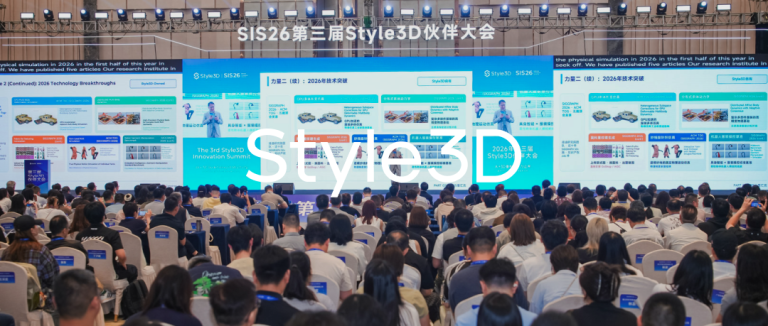
For this reason, the 2026 Style3D Innovation Summit carries a special significance. It is not only a discussion about trends, but also an exchange focused on action and real-world practice.
Why This Is a Conference About Action and Practice
The defining feature of this year’s Innovation Summit is not the presentation of concepts, but the demonstration of action and implementation.
Last year, Eric Liu proposed that “every company will have its own intelligent agents.” One year later, this prediction is gradually becoming reality, as more companies begin exploring how to integrate AI into their business workflows.
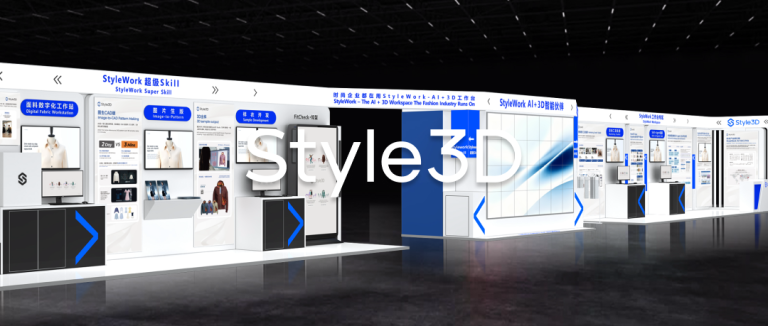
The products and solutions released by Style3D focus on real operational challenges such as efficiency and collaboration. The cases shared by speakers come from ongoing digital transformation practices across brands, manufacturers, and industry partners. The exhibition area no longer showcases technology alone, but real examples of how AI and 3D drive business growth.

The Apparel Industry Is Undergoing Its Third Paradigm Shift
Looking back at the history of the apparel industry, every major transformation has been driven by a leap in productivity.
In the mechanization era, industrial equipment such as sewing machines and spinning machines liberated human labor, solving the problem of “producing more.” In the digitalization era, software tools such as CAD, PLM, and 3D entered the value chain, solving the problem of “producing faster.”
Today, new technologies represented by AI, digital twins, and embodied intelligence are pushing the industry into the era of digital intelligence, solving the problem of “producing the right products with flexibility.”
What makes this revolution fundamentally different is that it does not replace human labor, but augments human intelligence, extending it into — and enabling it to act within — the physical world.
If the first two paradigm shifts improved efficiency by upgrading machines and software, the third shift is reconstructing the underlying logic of how the industry operates. Design, R&D, production, collaboration, and even organizational structures will all be redefined.
With the rapid advancement of embodied intelligence, AI is, for the first time, gaining a physical form — it can perceive materials, manipulate objects, and complete tasks in real-world environments. Apparel, as one of the most labor-intensive and least automated industries due to its reliance on soft materials and human expertise, is precisely where embodied intelligence holds the greatest potential. Whoever solves the challenge of flexible material manipulation in apparel will hold the key to the broader future of flexible manufacturing.
Based on this, Eric proposes a new perspective: embodied intelligence is the physical gateway to the third “industrial revolution”.

How the Apparel Industry Will Be Rewritten
Looking ahead to 2030, Eric outlines a clear evolution path for the industry: AI-driven demand perception + digital twin validation + embodied intelligence in production.
• AI-driven demand perception
AI will enable companies to truly understand and sense demand. With powerful reasoning and analytical capabilities, AI can help businesses better capture consumer preferences, shifting from experience-driven to demand-driven decision-making.
• Digital twin validation
Once demand is identified, how can it be validated quickly and cost-effectively? Digital twins provide the answer.
• Embodied intelligence in production
As embodied intelligence evolves, humanoid robots and robotic arms will increasingly collaborate with human workers, continuously transforming production methods.
In this future, the time gap between brands, designers, factories, and consumers will shrink from weeks to hours. The traditional linear supply chain will gradually evolve into a real-time collaborative network.
Competition in the apparel industry will shift toward operating systems, collaboration efficiency, and intelligent capabilities.
Building a Digital Twin World with Physical Properties
In the face of transformative technologies such as AI, intelligent agents, digital twins, and embodied intelligence, Style3D did not start its efforts in recent years.
Since its founding in 2015, Style3D has believed that “a digital world parallel to the physical world will inevitably exist.” This world will not only faithfully represent physical attributes such as fabrics, patterns, and craftsmanship, but will also be computable and verifiable, ultimately becoming part of everyday life.
Guided by this vision, Style3D has spent the past decade advancing physical simulation technology. From building apparel digital assets to achieving breakthroughs in physical simulation and establishing industry data infrastructure, its work extends beyond software to laying the foundation for the future digital world.
This is also why Style3D has consistently upheld its mission: to digitize the physical world.

From emphasizing the importance of data governance at the first Innovation Summit, to identifying the path of AI + 3D at the second, and now driving industry action at the third, the apparel industry’s third paradigm shift is already underway.
As Eric concluded: “Software defines apparel, intelligence reshapes the industry, and embodiment connects people and machines.” What truly matters now is not just recognizing trends, but turning them into action. This time, Style3D aims to work alongside the industry to become builders of a new era, and to jointly define the future of apparel.