Summary: Highlights from the 3rd Style3D Innovation Summit are here!
On June 4, 2026, the 3rd Style3D Innovation Summit was held at the Hangzhou Baosheng Water Expo Park Convention Center. More than 1,000 experts from domestic and overseas brands, manufacturers, supply chains, fabric and accessories companies, technology firms, universities, research institutions, and ecosystem partners gathered in Hangzhou to discuss the direction of transformation and practical implementation paths for the fashion industry in the AI Agent era.
From Trends to Practice: Discussing Development Opportunities in the AI Agent Era
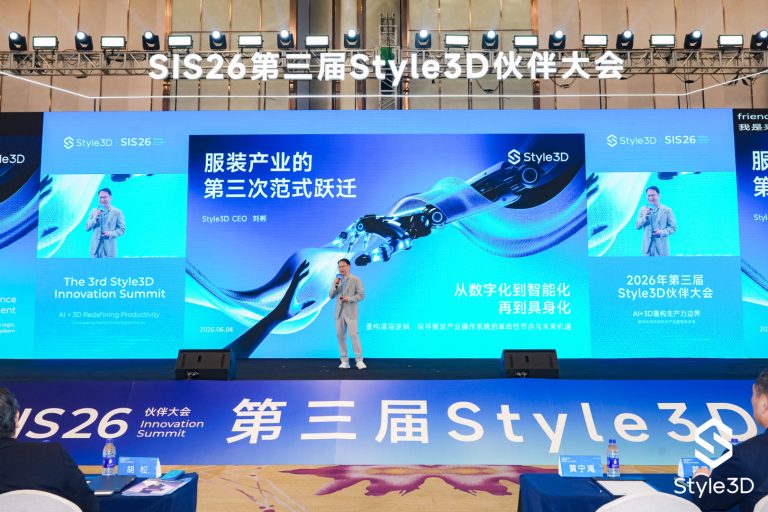
At the opening of the Innovation Summit, Eric Liu, founder and CEO of Style3D delivered a keynote titled “The Third Paradigm Shift in the Apparel Industry: From Digitalization to Intelligence to Embodiment.” He systematically explained the essence of the apparel industry’s evolution. Liu noted that the industry is moving through a critical stage from mechanization and digitalization toward digital intelligence. AI-based demand perception, 3D digital-twin validation, and the implementation of intelligent manufacturing will jointly drive the industry from a “forecast-based ready-stock business” toward “instant production based on confirmed demand.” Through the Style3D platform, Style3D aims to provide the industry chain with a digital foundation spanning design, R&D, production, and collaboration.
He concluded with three statements for the audience: “Software defines apparel,” “Intelligence reshapes the industry,” and “Embodiment connects people and machines.” Together, these three forces will create enormous development opportunities. He called on partners in attendance to “become participants and witnesses of this new era, and more importantly, builders of the apparel industry in the new intelligent era.”

Huang Ninghai, co-founder and CTO of Style3D, then took the stage to focus on how AI can truly become a “digital partner” for apparel companies. Using a typical customer need as an example, he revealed the collaboration pain points widely faced by enterprises today: scattered customer information, inconsistent asset storage, and excessive reliance on individual experience. From this, he introduced the arrival of the “AI colleague era,” in which AI is no longer a passively responding tool but a reliable partner with long-term memory and proactive collaboration capabilities.
On behalf of Style3D, Huang released StyleClaw, an AI central platform and digital partner platform built specifically for the apparel industry. The platform includes four major modules: a general assistant entry point, expert agents, a skills marketplace, and WeChat IM connectivity.

Zhao Guohua, Quality Director at Saint Angelo, shared how AI agents can solve challenges in the customized apparel industry in a presentation titled “What You Think Is What You See, and It Understands Me Better Than I Do.” With Style3D’s technical capabilities, Saint Angelo has built three core solutions: a measurement agent, diagnosis and design agents, and try-on and recommendation agents.
Saint Angelo’s three major agents have delivered strong results. The measurement agent improved measurement precision by 50% and achieved 95% accuracy compared with manual measurement. The diagnosis and design agents shortened average customer decision time by 30%. The try-on and recommendation agents increased conversion efficiency by 25% and reduced returns caused by non-quality issues by 10%. Zhao said that Saint Angelo will use AI as the engine and professionalism as the foundation to make “what you see is what you think, and it understands me better than I do” a reality.

Afterward, a number of university experts and enterprise representatives shared insights on AI technology trends, the direction of industrial transformation, and enterprise digital transformation paths.
Jia Xizeng, professor and doctoral supervisor at Tsinghua University, shared the core ideas behind the “Huadi Pattern Foundation Model,” developed in collaboration with Style3D, from three perspectives: “text as the foundation,” “scenario-driven development,” and “human-machine collaboration.” Professor Jia particularly emphasized the importance of text. In his view, two-thirds of the design process consists of text construction, while visual presentation is only the final stage. Through specific case analyses, he explained how to start from cultural semantics and philosophical thought to build a narrative pattern design process and achieve the modern visual transformation of traditional Chinese culture.

Wang Zhaohui, Vice Dean of the College of Fashion and Design at Donghua University, introduced from an education perspective the apparel teaching agent jointly developed by Donghua University and Style3D. Combining Style3D’s big-data support with Donghua University’s professional knowledge base, the agent supports three core functions: guidance based on professional parameters, multimodal generation, and three-dimensional aesthetic evaluation. It can assist students through the full closed loop of AI design, AI evaluation feedback, AI guidance reference, and AI revision. Wang said, “The addition of AI assistants and the construction of an AI agent platform will help future classrooms; in the future, learning will increasingly take place through interaction with AI.”

Hu Lulu, head of algorithms for Alibaba ATH intelligent terminals, introduced the Qwen large-model family and its industrial implementation. He showcased core Qwen products including Qwen-Omni for multimodal interaction, Qwen-3.7-Plus for multimodal understanding, and the flagship model Qwen-3.7-Max. He also shared implementation practices for large models in enterprise offices, operations management, and consumer products across application scenarios such as code generation, intelligent translation, and multimodal reasoning, demonstrating the broad prospects of AI technology from capability breakthroughs to industrial applications.

Vincent Siau, Managing Director, and Dieter Balcaen, Head of Production at Alsico Europe, one of the world’s largest professional workwear manufacturers, shared the company’s digital transformation practices in the workwear industry. They claimed that the workwear industry is shifting from a traditional “supply-driven” model to a “demand-driven” model, and digital design is the key to driving this transformation. With Style3D, Alsico can complete design validation before production; 50 different versions of the same garment can be modified within minutes; the product development cycle has been shortened from 9 months to weeks or even days; and the collaboration across 10 commercial units and 21 factories remains consistent. At the same time, 3D visualization enables customers to participate in design reviews and solution adjustments in real time. Looking ahead, Alsico hopes to further enhance global business collaboration through digital technologies, reduce resource waste, and explore a new model in which employees participate independently in workwear design through mobile devices.

Fran-Dressie is an ODM apparel design, manufacturing, and export company. Chairman Lu Xiaoxiang focused his sharing on the digital transformation of China’s apparel manufacturing industry. He said directly, “The digital-intelligent model is the future model of apparel manufacturing. It represents high-quality production capacity today and the only model for human apparel manufacturing in the future.” During three years of cooperation with Style3D, Fran-Dressie has gradually achieved digital-intelligent transformation in product design and manufacturing. Revenue increased 55% year over year in 2025 and is expected to grow by more than 60% again this year. He commented that Style3D’s digital-intelligent capabilities in marketing and design are already at the forefront globally and still have enormous room to grow.

From macro industry trends to application practices, the speeches by the Innovation Summit speakers fully illustrated the new opportunities and challenges facing enterprises in the AI Agent era, providing rich thinking and reference points for the future development of the industry.
AI+3D Implementation Practices: Answers from the Front Lines of Industry
During the afternoon customer implementation sharing session, many brands, supply chain companies, and partners presented achievements in AI+3D applications.
Digital partners are becoming an important direction for the digital-intelligent upgrading of the apparel industry. Zhou Bin, founder of Kimhaie (Hangzhou), introduced Kimhaie’s planning and practice for its digital employee system. He said, “By 2026, single-point AI tools are no longer a competitive advantage; everyone is using AI.” The real future lies in introducing digital employees, AI agents that can autonomously call system data and execute end-to-end tasks.
Based on this judgment, Kimhaie is accelerating improvements to its data foundation and completing its systems to prepare for agent implementation. Over the next two years, Kimhaie plans to introduce 22 to 25 digital employees covering asset entry, marketing and customer acquisition, design and R&D, order processing, production scheduling, quality analysis, and delivery document generation. Zhou made clear that the purpose of digital employees is to “free physical employees from complicated work and let them spend their brains on ideas.” At present, around 30% of Kimhaie’s digital employees have entered testing and application, and the company is moving toward a new stage of development in which “people and agents use systems together.”


In the overseas brand sharing session, representatives from The Very Group, a leading online retail group in the United Kingdom, and Carhartt WIP (Carhartt Work In Progress), the European fashion line of the century-old American workwear brand Carhartt, jointly shared enterprise practices.Joseph Danson, Head of Sourcing, and Joe Zhang, Country Manager (China), presented The Very Group’s digital transformation journey and how its partnership with Style3D is helping the business respond faster to consumer demand. Serving more than 4 million customers, The Very Group has achieved remarkable results through the adoption of 3D and AI-powered workflows:
-
Lead time reduced from 20 weeks to 12 weeks
-
Product development cycle shortened from 6 weeks to 2 weeks
-
Hit rate increased by 25%
-
Color and style approval rate improved by up to 75%
By replacing physical sampling with virtual samples and embracing collaborative 3D development, The Very Group is improving speed, efficiency, and supplier collaboration across the product lifecycle.
Adriana Gochez, Digital Project Manager, and Annika Albrecht, Team Lead 3D Development, shared how Carhartt WIP is building a connected digital ecosystem across its global operations.
Through the integration of Style3D with its PLM system, Carhartt WIP has established a centralized workspace that:
-
Connects global teams through real-time collaboration
-
Eliminates duplicated work and fragmented communication
-
Provides holistic visibility across menswear, womenswear, and accessories collections
-
Supports faster and more informed decision-making
With Style3D digital boards, Carhartt WIP can centrally manage design sketches, 3D previews, and product information, connecting cross-regional and cross-category collaboration workflows and significantly improving merchandising planning and development efficiency. In the future, Carhartt WIP also plans to extend Style3D capabilities further into supply chain management and marketing to promote end-to-end digital collaboration.

Du Ling, Deputy General Manager of GDTEX, shared the company’s digital-intelligent transformation practices. As an apparel trading enterprise deeply engaged in the global market, GDTEX has continued to build digital capabilities in recent years, exploring pathways for new quality productive forces through the dual drivers of global layout and digital technology innovation. Since beginning cooperation with Style3D in 2021, GDTEX has continuously deepened 3D and AI applications, covering planning, design, production, sales, marketing, and other full-business-chain links. Through Style3D products, the AI design selection rate and 3D sample adoption rate of Guangdong Textiles both increased from 30% to 60%, significantly improving development efficiency and market responsiveness. Du said that in the future, the company hopes to use AI agent capabilities to achieve deeper application in scenarios such as brand planning, style matching, and intelligent style generation and recommendation, continuously improving its ability to serve global customers.


Shen Fenglin, General Manager of Orient International Holding Shanghai Rongheng International Trading Co., Ltd, introduced Rongheng’s exploration and achievements in AI+3D applications based on digital practices in the underwear category. She noted that compared with ordinary apparel, underwear products face simulation challenges in 3D modeling involving complex materials such as cups, underwires, mesh, and lace. Since beginning cooperation with Style3D in 2024, Rongheng has gradually overcome these challenges and applied Style3D AI+3D tools to design, procurement, production, display, and other processes. At present, Rongheng has realized innovative applications such as rapid iteration of customer style designs, AI pattern design, and generating line drawings from drafts, effectively improving product development efficiency and greatly reducing the number of physical samples. Shen said she hopes to continue working with Style3D and other industry partners in the future to explore broader application space for 3D digitalization in the underwear industry.

Based on real business scenarios, speakers shared practical experience in using Style3D to build digital asset systems, optimize R&D processes, improve customer collaboration efficiency, and accelerate product launch cycles. These cases show that AI+3D technology has gradually moved from conceptual exploration to scaled application, and is becoming an important tool for helping enterprises reduce costs, improve efficiency, and strengthen competitiveness.
In the final debate roundtable session, Alfie Chen, Style3D COO, Zhang Jingyan, Apparel Vice President at Kashion Fashion, and their digital partners engaged in a spirited debate around the question “Are AI digital partners assistants or opponents?” The debate had no absolute winner. AI’s capabilities are determined by technology, but its positioning, boundaries, and future will always be defined by humans. The human-machine relationship should not be a confrontational game, but a long-term process of continuous symbiosis and mutual achievement.

Ecosystem Collaboration: Creating the Future of the Industry Together with Partners
A number of signing and launch ceremonies were held at the Innovation Summit, including the co-creation R&D signing for the “AI Agent Customized Service Foundation Model” with Saint Angelo, the release of the Huadi Pattern Foundation Model with Tsinghua University, the release of the apparel digital learning agent with Donghua University, and the launch of the national fashion intelligence industry-education integration ecosystem development plan, jointly promoting the deep integration of AI technology and the fashion industry.
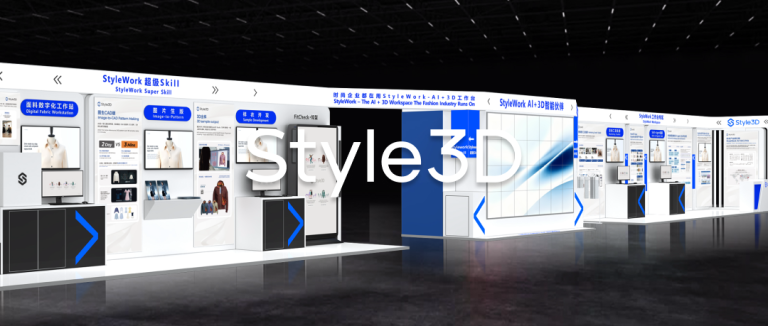
In addition, this year’s Innovation Summit featured both a product experience area and an interactive experience area. Through on-site experiences, attendees gained deeper insight into the application value of Style3D across business scenarios such as design and R&D, digital asset management, marketing display, and supply chain collaboration. In the interactive experience area, AI+3D implementation applications from various brands and manufacturers attracted many guests to stop and try them.

The rich exhibition content showcased Style3D’s technological innovation achievements, giving attendees a more intuitive sense of the changes AI+3D is bringing to the industry and further promoting ecosystem collaboration among partners.
Industry Study Tour: Entering the Sites of Innovation
On the second day of the Innovation Summit, attendees set out in groups on industry study tours. Through field visits and in-depth exchanges, they gained deeper understanding of practical achievements and innovative experience in digital transformation, while also identifying cooperation opportunities and development inspiration.


The two-day agenda was both a future-oriented industry dialogue and a gathering of global innovation forces. The 3rd Style3D Innovation Summit not only showcased the latest technological achievements and industrial practices in AI+3D, but also further consolidated consensus and collaboration across the global fashion ecosystem.
From the first Innovation Summit, “Doing Better Business in a New Era,” to the second, “New Paths for AI+3D,” and now to this year’s focus on “New Practices in Technology-Driven Business Paradigms,” the Style3D Innovation Summit has continued to connect industry and technology, trends and implementation, ecosystem and co-creation. Standing at a new starting point in the AI Agent era, Style3D will continue to work hand in hand with global partners to promote the deep integration of AI and 3D technologies in the fashion industry, jointly moving toward a smarter, more efficient, and more imaginative industrial future.