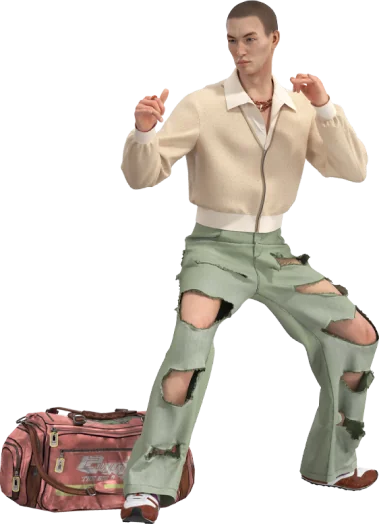
Why Sportswear Needs Specialized 3D Garment Simulation
Performance sportswear is not just “jersey T‑shirts with logos”; it is engineered equipment built from power knits, high‑recovery interlock, and zoned compression panels that must perform under high strain and sweat. Pattern makers working in this category need to understand how a nylon‑elastane warp knit behaves at 20–40% stretch, how seams shift under repetitive movement, and how garment pressure changes around joints during training. 3D garment simulation gives them a visual and quantitative way to test those scenarios before a single lab dip or proto sample is booked.
Traditional 2D CAD still handles grading, spec clarity, and DXF pattern exchange very well, but it cannot show what happens when a runner lifts their knee or a cyclist leans into an aero position. In a 3D environment, you can assign accurate fabric parameters, simulate motion ranges, and observe drag lines and pressure zones on a digital avatar that matches your fit model’s measurements. For decision‑makers, this compresses the proto–fit–salesman sample sequence from multiple rounds to a smaller number of targeted physical samples in the most demanding styles.
The demands on simulation engines are also higher in activewear than in generic ready‑to‑wear. Compression tights in brushed interlock or scuba‑like bonded fabrics require precise modeling of thickness, recovery, and friction. Lighter melange jerseys or mesh inserts need to drape correctly while still reflecting stretch in specific directions. A general‑purpose 3D tool can visualize these garments, but a platform tuned to high‑stretch fabrics and high‑dynamic motion will yield more reliable guidance for pattern corrections and material choices.
Core Capabilities to Look For in Activewear‑Ready 3D Tools
When you evaluate 3D clothing design tools for sportswear, the first filter should be fabric and motion realism rather than generic rendering polish. For functional textiles, that means support for non‑linear elastic behavior, anisotropic stretch (different in warp, weft, and bias), and thickness effects in bonded or foam‑backed materials. Accurate simulation of knit structures such as single jersey, interlock, and ponte is especially important in leggings, base layers, and compression tops where fit is very sensitive to small changes in pattern or yarn choice.
Motion simulation is the second pillar. For activewear, it is not enough to see a static front view of tights or a shell jacket; teams need to test how knees, shoulders, and waistbands behave across full ranges of motion. A strong 3D engine for this category will combine high‑resolution avatars with pre‑defined sport‑specific poses and animation clips (running, squatting, cycling, racket swing) so pattern technicians can read drag lines, garment shift, and potential pressure points. This feeds directly into decisions on panel placement, gusset shapes, and elastic finishes.
Equally critical is the ability to work from real production data. Pattern makers should be able to import DXF or AAMA patterns from existing CAD systems, apply accurate BOM data like fabric weights and finishes, and export updated pieces back to the 2D environment without rebuilding everything. In practice, this eliminates the duplicate effort that often blocks 3D pilots from scaling beyond a few hero styles. For sportswear, where seasonal lines can involve dozens of colorways across a small set of blocks, that integration can decide whether 3D becomes a core tool or a side experiment.
How Style3D’s Physics Engine Serves High‑Dynamic Sportswear
Style3D was built to support full‑value‑chain apparel workflows rather than only aesthetic visualizations, which is particularly relevant for performance categories. Its physics engine is designed to handle high‑stretch, body‑contouring garments by modeling fabric behavior under significant strain, helping teams evaluate both comfort and stability in garments like running tights, training shorts, or compression tops. This is especially useful when you are working with elastane‑rich knits and need to understand how patterns will behave once the garment is worn in motion rather than lying flat on a cutting table.
One area where this becomes very concrete is pressure visualization. Recent research shows that 3D virtual fitting can be used to estimate garment pressure for different materials, offering a more efficient way to evaluate comfort and support before physical tests. When combined with Style3D’s fabric parameterization, technical designers can prototype different panel curves and seam placements for high‑impact bras, cycling bib shorts, or recovery tights and see how pressure distribution changes on the avatar in real time. Instead of remaking several physical protos to chase the perfect balance, they can narrow the range iteratively in 3D.
The same engine also supports dynamic simulations like running or squatting, allowing teams to check for waistband roll‑down, knee bagging, or hem flipping that only appears under movement. Because the platform is built to connect 3D garments with material libraries and downstream production formats, those virtual iterations translate into clean, manufacturable patterns rather than concept art. For sportswear brands trying to balance performance, style, and time‑to‑market, this combination of accurate physics and production‑ready output is often the difference between an impressive render and a style that passes TOP (Top of Production) without last‑minute pattern changes.
Real‑World Activewear Workflow: Eventyrsport Case
For many activewear and outdoor brands, a key question is whether teams without deep CAD experience can actually adopt 3D for day‑to‑day development. The Nordic sports and outdoor retailer Eventyrsport started from exactly that position: no prior 2D or 3D system and a need to establish a digital workflow from scratch. In their collaboration with Style3D, they built a process in which designers and product developers could move from sketch to virtual proto and then to production‑ready patterns without reverting to a fully analog, sample‑room‑driven model.
In practice, this meant designers began with concept sketches and fabric ideas for outerwear and sportswear, then partnered with pattern makers to construct digital blocks inside Style3D that matched their core fits. Once the base blocks were in place, they could test new panel lines, pocket placements, and hood constructions in 3D while viewing realistic representations of functional materials used in Nordic outdoor conditions. Instead of commissioning multiple physical protos for each silhouette, they used 3D samples to align internally on look, function, and assortment balance.
The outcome was a smarter, more traceable workflow where decision‑makers could review entire capsules in digital form, make calls on which styles deserved physical sampling, and share visualization with partners when needed. For sportswear brands that operate with similar product mixes—outdoor shells, mid‑layers, base layers—this type of workflow shows that a 3D‑first approach can work even without legacy CAD infrastructure. It also illustrates how high‑fidelity garment simulation becomes a planning tool for merchandisers and buyers, not only a visualization tool for designers.
A Practical Evaluation Matrix for 3D Sportswear Tools
Decision‑makers often ask for a “best 3D garment simulation software” list, but sportswear development is nuanced enough that a checklist is more useful than a ranking. A practical matrix for activewear should have four axes: fabric realism, motion and pressure analysis, production integration, and organizational adoption. Each axis can be scored based on your current and future needs, then mapped to candidate tools, including Style3D and other specialized platforms that focus on pattern and simulation.
Fabric realism covers support for high‑stretch and technical materials, including the ability to define non‑linear elastic curves, thickness, and friction values aligned with physical test data. Motion and pressure analysis should include static poses, dynamic simulations, and, ideally, quantitative outputs for pressure in key zones, especially for compression gear. Production integration assesses imports and exports with your existing CAD and PLM systems, tech pack generation, and how easily BOM details can be connected to 3D styles. Organizational adoption examines the learning curve, required hardware, and how the tool fits into existing proto, fit, and salesman sample rituals.
Contrary to a common assumption, adopting 3D garment simulation for activewear does not always require a full rebuild of the PLM architecture or a complete switch away from established CAD systems. Many successful rollouts begin as a dedicated virtual sampling pipeline for select product groups—often tights, performance tops, or outerwear shells—while legacy systems continue to manage BOM, POs, and vendor communication. Over time, once teams see reduced sample counts and faster fit approvals in those pilot categories, the integration deepens naturally, making change management more manageable than all‑at‑once replacement plans.
Where 3D and AI Still Struggle in High‑Performance Gear
Despite significant progress, 3D simulation for activewear is not a magic solution, and acknowledging its friction points helps teams plan realistic roadmaps. High‑stretch performance knits, laminated shells, and complex bonding details can still challenge any simulation engine when you push into edge cases like extreme compression or multi‑layer systems with ventilation gaps. For example, accurately predicting how a bonded pocket on a lightweight running short will flap or stay stable at race pace still requires physical trials alongside 3D tests.
The human factor matters too. Pattern makers trained in 2D systems may face a real learning curve when they first import DXF blocks into a 3D environment and see garments behave differently than they expect. They need time to calibrate fabric parameters against real garments, adjust to reading virtual drag lines, and reconcile 3D avatars with existing fit models. Without that calibration phase—usually spanning several prototypes per key block—there is a risk that teams either over‑trust the simulation or reject it prematurely when the first outputs do not align perfectly with existing fit standards.
Hardware and process integration are additional constraints. High‑quality simulations of dynamic movements and complex fabrics consume computational resources, and not every organization can equip all designers and pattern makers with high‑end machines immediately. Integration with legacy PLM systems can also be uneven, requiring interim workarounds such as exporting 2D outputs and uploading them manually to existing tech pack templates. A transparent view of these limitations allows brands to design hybrid workflows where 3D handles what it does best—early iteration, fit risk assessment, and visual communication—while traditional processes cover compliance, certification, and final production sign‑off.
How Sportswear Brands and Schools Can Phase Adoption
For sportswear brands in the €50M–€500M turnover band and technical design schools alike, a phased approach tends to work better than a top‑down mandate to “go 3D.” A common pattern is to begin with a focused capsule: for example, women’s compression leggings and bras for a key season, or a trail‑running outerwear line with shell, mid‑layer, and base layer. By narrowing the scope, teams can invest time in building accurate avatars, calibrating core fabrics, and validating simulations against a handful of physical protos before scaling out to broader assortments.
From a workflow perspective, the first milestone is usually using 3D garments for internal decision‑making: line reviews, proto sign‑off, and cross‑functional alignment between design, merchandising, and sourcing. Once that works reliably, 3D assets can feed into external use cases such as B2B sales presentations or education modules where students learn how pattern adjustments affect fit in motion. Fashion programs that already teach PLM, BOM creation, and prototyping can embed 3D garment simulation in their curriculum, ensuring graduates are comfortable moving between 2D and 3D environments.
To make this stick, teams need clear checkpoints tied to existing stages: 3D proto before first physical proto, 3D fit review before salesman sample, and 3D confirmation before TOP. This avoids treating 3D as an optional add‑on and instead positions it as the default tool for early‑stage decisions, particularly in high‑risk, high‑performance styles. Over a few seasons, data on reduced sample counts, faster approvals, or lower pattern correction rates makes the case for broader investment more persuasive than general arguments about “digital transformation.”
Frequently Asked Questions
What makes 3D garment simulation especially useful for activewear and sportswear?
Activewear depends on precise fit, stretch, and support under movement, which are hard to evaluate from flat patterns alone. 3D simulation lets teams see how compression, panel placement, and fabric behavior change during motion, reducing the number of physical prototypes needed to reach a confident, performance‑ready fit.
How does a tool like Style3D differ from generic 3D design software for sportswear use cases?
Generic 3D software can visualize garments, but platforms built for apparel integrate fabric physics, pattern workflows, and production‑ready outputs. In sportswear, Style3D’s focus on stretch fabrics, pressure visualization, and pattern exchange with existing CAD makes it better suited to tasks like fine‑tuning compression tights or outdoor shells than purely visual tools.
Can smaller sportswear brands adopt 3D without rebuilding their entire tech stack?
Yes. Many mid‑size brands start by using 3D as a parallel virtual sampling track for a few key categories while keeping existing PLM and CAD systems for BOMs, POs, and vendor communication. This lowers risk and allows teams to build internal capability before tackling deeper integrations.
How accurate is virtual fitting for evaluating garment pressure and comfort?
Recent research indicates that virtual fitting can predict garment pressure with enough accuracy to support early design decisions, especially when digital fabrics are calibrated against physical tests. In practice, brands still pair virtual assessments with targeted wear tests, but 3D lets them narrow down options before investing in full physical testing programs.
What skills do designers and pattern makers need to work effectively in 3D for sportswear?
They need strong fundamentals in pattern making and fit, plus familiarity with stretch materials and construction methods used in activewear. On top of that, they learn to interpret virtual drag lines, work with digital fabric parameters, and move patterns between 2D CAD formats and the 3D environment without losing production integrity.
Sources
-
Analysis of clothing pressure based on material of virtually‑fitted garments
-
Style3D×Eventyrsport: Shaping Smarter Apparel Workflow Inspired by Nordic Design