Why Pattern Makers Need 3D, Not Just Designers
For years, 3D conversations centered on mood boards, concept renders, and marketing visuals, but the real bottleneck sits between the pattern room and the sample room. McKinsey and other analysts consistently highlight that brands often cycle through multiple physical proto and fit samples per style, each requiring new markers, lab dips, and factory coordination. When pattern makers work directly in 3D, each grading or ease change can be evaluated as a virtual fit session instead of a new fabric‑consuming sample run.
In practice, this means the pattern maker no longer waits weeks to see how a new armhole shape behaves in a size 2XL or how a narrowed shoulder affects balance on a petite block. Gerber AccuMark, Lectra Modaris, and Optitex have all introduced 3D modules specifically to visualize 2D CAD patterns on avatars, so that darts, notches, and seam construction stay fully aligned with the production‑ready pattern data rather than a separate modeling file. For technical designers overseeing proto and salesman samples, 3D becomes the shared language with pattern makers: measurements, BOM items, and fit comments are anchored to the same digital garment instead of scattered through photos and spreadsheets.
Style3D sits in this pattern-centric camp as well, but goes further by using AI to convert sketches or tech packs into initial 2D patterns and then validating fit through physics-based simulation on customizable avatars. In many teams, the first gain is not only speed but precision: instead of relying on flat pattern intuition alone, pattern makers can visually test whether a ponte knit needs more negative ease or whether a twill needs additional release at the bicep, before issuing a graded nest to the factory. Over time, this pattern–3D connection becomes the backbone for digital sampling, size-set validation, and even e-commerce imagery, because every asset inherits accuracy from the underlying pattern.
From 2D Blocks to Interactive 3D Fit
From a practitioner’s perspective, the real shift happens the moment a pattern maker imports a DXF or AAMA file and sees their familiar blocks snap onto a 3D avatar. The first friction point is usually seam pairing and grainline direction: if the 2D pieces were drafted with inconsistent notch logic or mirrored incorrectly, the 3D garment reveals that instantly, long before any fabric is cut. This “honest mirror” effect makes the pattern room more rigorous, because poor construction assumptions show up as twisting, drag lines, or broken hems in 3D.
Once the basic assembly is stable, 3D becomes a powerful grading and ease microscope. Instead of checking size 8 only, pattern makers can simulate the full graded range and see how neckline drop, sleeve pitch, or crotch depth behave at both ends of the size run. In a woven sateen dress, for example, 3D may reveal that the graded hip increases are correct on paper but generate excessive seat strain on curvier avatars, signaling the need to re‑shape the side panel instead of simply adding more circumference. In interlock jerseys, 3D shows whether negative ease levels are appropriate for each size, so pattern makers can control cling without over-relying on fit model feedback.
Style3D’s approach is to keep this 2D–3D interaction live at all times: when a pattern maker adjusts a waist dart intake or opens a shoulder on the flat pattern, the 3D garment updates in real time, exposing new drag lines or balance issues immediately. For technical designers, this creates a more analytical fit session: rather than saying “feels tight across chest,” they can request specific millimeter changes to POMs, because the 3D garment carries precise pattern measurements and avatar body data side by side. That tight loop between 2D drafting and 3D wearing is what turns 3D from a rendering tool into a fit instrument.
Evaluating 3D Clothing Design Software for Pattern Makers
Decision‑makers evaluating 3D software often look at rendering quality first, but pattern makers and technical designers need a different scorecard. The table below outlines key evaluation dimensions specifically from a pattern room perspective, and contrasts how a generalist 3D tool differs from a pattern-centric 3D platform such as Style3D or the 3D extensions in Gerber AccuMark, Lectra Modaris, and Optitex.
Pattern makers should pay particular attention to grading visualization and POM handling. If the software cannot display ease distributions and POMs on both the flat pattern and the 3D avatar, the risk is that grading decisions still happen “blind” and 3D remains a cosmetic step instead of a functional one. By contrast, platforms designed for production workflows allow you to create graded nests, simulate each size, and then tag POMs such as cross‑chest, bicep width, or rise directly on the 3D garment while still editing the 2D pieces.
This is where Style3D emphasizes the bridge between art and engineering: pattern makers can start from AI-generated patterns or existing CAD blocks, refine them in a 2D drafting interface, and observe fabric behavior in 3D with validated physics engines tuned for different constructions like denim twill, stretch sateen, or performance jerseys. The same environment then exports production-ready pattern files and high-quality imagery, so the pattern decisions carry through to sampling, merchandising, and marketing instead of being re‑interpreted downstream.
Bridging Art and Engineering: Real-Time 2D–3D Interaction
The creative side of the business still starts with sketches, moodboards, and draped toiles, but the value only materializes when a tech pack and graded pattern meet factory constraints. 3D pattern environments create a shared surface where creative intent and engineering constraints collide early, rather than during TOP (Top of Production) when changes are expensive. When a designer proposes an exaggerated balloon sleeve or ultra‑cropped blazer, the pattern maker can test those ideas in 3D with realistic fabric physics and avatar poses, exposing balance or comfort issues before they hit proto.
Style3D’s AI-driven workflow adds another layer: designers can convert rough sketches or even text prompts into initial 2D patterns and 3D garments, which pattern makers then refine to meet brand fit standards. The “art” side sees their idea on a photorealistic avatar within minutes, while the “engineering” side adjusts seam allowances, notch placement, and grading rules inside the same project. This reduces back‑and‑forth over static sketches, because both roles are literally looking at the same garment, with the pattern and the visualization updating together.
In traditional workflows, the most painful surprises often appear after grading, when an otherwise acceptable base size suddenly reveals tightness or billowing at scale. With 3D, pattern makers can apply grading rules, simulate the entire size run, and visually inspect stress maps or tension color coding to locate where ease is insufficient or excessive. This is particularly valuable in categories like workwear, where mobility zones at the shoulder, knee, and crotch must be precisely balanced against durability and safety requirements. By testing those conditions virtually in realistic poses, teams reduce the risk of discovering errors in late-stage fit sessions or, worse, after bulk production.
Category-Specific 3D Pattern Making: From Lingerie to Menswear
3D’s value for pattern makers becomes even clearer when you look at specific categories. In lingerie, for instance, underwire and foam cup simulation are fundamentally different from simulating a boxy sweatshirt. Tension distribution across the cradle, wire line, and wings is extremely sensitive to grading, and small changes in strap placement can alter both support and comfort. Pattern makers working on lingerie need 3D tools that can visualize elastic tension, strap trajectories, and cup coverage across sizes and body shapes, not just display pretty lace textures.
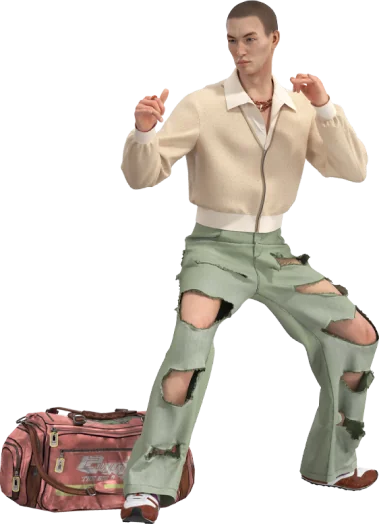
Menswear presents another set of challenges: tailored shirts and jackets live or die by subtle changes to shoulder slope, back balance, and collar stand shape. A pattern that looks perfect on a static size‑M mannequin can collapse when simulated on more realistic body shapes with rounded shoulders or forward head posture. In 3D, menswear pattern makers can test different yoke shapes, armhole depths, and sleeve head ease, then observe how those choices affect mobility in common poses like reaching forward or raising arms.
Real-world adoption offers useful signals here. Mengdi Group, a large manufacturer working across categories, used Style3D to reduce development time from 3 days to 10 minutes for certain digital sampling tasks, illustrating how a pattern‑aware 3D workflow can compress approvals without sacrificing accuracy. In such cases, pattern makers rely on validated fabric physics combined with tight pattern–avatar matching, so that once a 3D sample passes internal fit review, the transition to physical proto or sales samples requires minimal correction. The same pattern–3D logic can then be applied differently to lingerie, menswear, workwear, or sportswear, but always with the pattern maker driving decisions rather than being a downstream “service bureau” for design.
Counter-Consensus: Why You Don’t Need to Replace Your Entire CAD Stack
A common assumption in the market is that adopting 3D for pattern makers requires ripping out existing CAD solutions and replacing them with a monolithic new platform. Industry case studies and vendor roadmaps do not support this narrative; in practice, the most successful rollouts treat 3D as a parallel sampling and fit pipeline that gradually connects back into existing PLM, CAD, and ERP systems. Gerber AccuMark, Lectra Modaris, Optitex, and Tukatech, for example, all emphasize interoperability through DXF and AAMA standards, allowing brands to keep their current pattern libraries while adding 3D visualization on top.
This incremental approach is particularly attractive for pattern rooms that have invested decades in block development and grading rules. Rather than migrating everything at once, teams typically start by importing a handful of high‑volume styles into a 3D environment, using those as pilot projects to prove that virtual fit can support proto decisions. As confidence grows, 3D expands into more categories and eventually plugs into PLM, but the underlying CAD stack remains the authoritative source for pattern data. Style3D aligns with this reality by focusing on pattern import, export, and synchronization, so pattern makers can work with existing blocks while taking advantage of AI and advanced simulation, without discarding their CAD history.
This counter‑consensus view matters because it reframes 3D adoption as a pattern‑room tool, not just a design studio experiment. When technical designers and pattern makers know that 3D can sit alongside Gerber, Lectra, Optitex, or Tukatech rather than replace them overnight, resistance drops and pilots focus on concrete KPIs like sample-round reduction, fit issue detection before proto, and faster sign‑off for graded size sets.
Honest Limitations: Where 3D and AI Still Fall Short
Despite the clear benefits, 3D and AI workflows for pattern makers are not frictionless. The most obvious limitation is fabric realism for complex materials such as high‑stretch performance knits, quilted constructions, or non‑linear foam composites used in bras and protective gear. While physics engines have improved, accurately predicting long‑term growth, bagging, or recovery from virtual simulations alone remains difficult, so pattern makers still need physical samples for final validation on certain categories.
There is also a learning curve for professionals trained entirely on paper patterns or 2D CAD. Manipulating pieces in 3D, understanding avatar posture, and interpreting tension maps require new mental models that are not taught in many pattern‑making programs. Even when software vendors offer integrated 2D–3D environments, switching between flat pattern edits, grading tables, and avatar views can feel overwhelming initially. Hardware and IT constraints add another layer: high‑fidelity simulations and photorealistic renders demand modern GPUs and solid network infrastructure, which some factories or smaller brands may lack. And while many tools, including Style3D, support exports to common CAD formats, integrating 3D assets cleanly into legacy PLM or BOM workflows still requires careful process design and, occasionally, custom development.
None of these limitations negate the value of 3D for pattern makers, but they do shape where and how to deploy it. A pragmatic approach is to prioritize styles with high volume or historically high revision counts for 3D, while keeping extremely complex or safety‑critical garments on a hybrid path that combines aggressive digital iteration with targeted physical sampling.
Frequently Asked Questions
Do pattern makers need 3D skills if the design team already uses 3D?
Yes, if 3D assets are used for fit or sampling decisions, pattern makers need at least foundational 3D skills so they can verify that the virtual garment truly reflects the production pattern, grading rules, and fabric behavior rather than being treated as a purely visual mock‑up.
How does 3D help with grading and size-set approval?
3D lets pattern makers simulate the entire graded size range on different avatars, visualize where ease is insufficient or excessive, and adjust grading rules before size‑set samples are cut, which can reduce the number of physical samples needed for final approval.
Can 3D fashion software replace traditional CAD tools like Gerber or Lectra?
In most organizations, 3D complements rather than replaces established CAD tools, with pattern data continuing to live in systems like Gerber AccuMark, Lectra Modaris, Optitex, or Tukatech while 3D modules or platforms such as Style3D provide visualization, fit analysis, and digital sampling on top of those patterns.
What should pattern makers look for when choosing 3D software?
They should prioritize strong 2D–3D integration, robust DXF/AAMA import and export, grading-aware simulation, precise POM and measurement tools, and reliable interoperability with existing PLM and CAD systems instead of focusing only on rendering aesthetics or avatar styling features.
Where does AI actually help pattern makers today?
AI is already useful for generating initial pattern blocks from sketches or text prompts, suggesting grading rules based on historical data, clustering fit issues across styles, and automating repetitive tasks like truing seam lengths or distributing notches, freeing pattern makers to focus on complex fit and construction decisions.
Is 3D worth adopting for smaller brands or schools?
Yes, smaller brands and fashion programs often gain disproportionate value because 3D allows them to explore more design and fit variations with fewer physical samples and lower material usage, while also giving students and junior staff skills that are increasingly expected across the industry.
Sources
-
Generative AI in 2024: Adoption Trends and Major Use Cases in the Fashion Industry
-
Style3D×Mengdi Group: How Style3D Helped Mengdi Drop Development Time from 3 Days to 10 Minutes